Is Boron Limiting Your Corn Yield?
Feb 19, 2026
When corn plants reach tasseling and early reproductive stages, there are many important factors at play supporting their healthy development. One that’s often overlooked but can have a sizeable impact is the presence of boron. When sufficient, boron supports healthy reproduction and sugar transport throughout the plant. When deficient, yields can be compromised as the plant struggles to produce pollen and keep its leaves nourished.
To avoid these negative impacts in your fields this season, let’s dig further into the importance of boron, the role it plays and guidelines for application.
Why is boron so important?
To avoid these negative impacts in your fields this season, let’s dig further into the importance of boron, the role it plays and guidelines for application.
Boron plays a key role in flowering, pollen development and viability, and the pollination process. Most boron is accumulated in the corn plant just prior to pollination to support reproductive growth in tassels and ears.
However, because it is mobile in the soil, boron can leach from the soil profile, especially during wet conditions, which can negatively affect plant uptake and yield potential. If boron is not available, plants produce pollen without the starch required for growth once the pollen lands on a silk. A severe boron deficiency may result in a completely barren plant where an ear shoot may not even develop.
Boron plays a key role in flowering, pollen development and viability, and the pollination process. Most boron is accumulated in the corn plant just prior to pollination to support reproductive growth in tassels and ears.
However, because it is mobile in the soil, boron can leach from the soil profile, especially during wet conditions, which can negatively affect plant uptake and yield potential. If boron is not available, plants produce pollen without the starch required for growth once the pollen lands on a silk. A severe boron deficiency may result in a completely barren plant where an ear shoot may not even develop.
How common are boron deficiencies?
Early-season rains can move boron out of the corn root zone, increasing the risk of deficiency. Also, boron is relatively immobile once in the plant. This means that too much moisture could potentially leach boron away from the roots in the soil and too little moisture may further amplify mobility issues once boron gets into the plant.
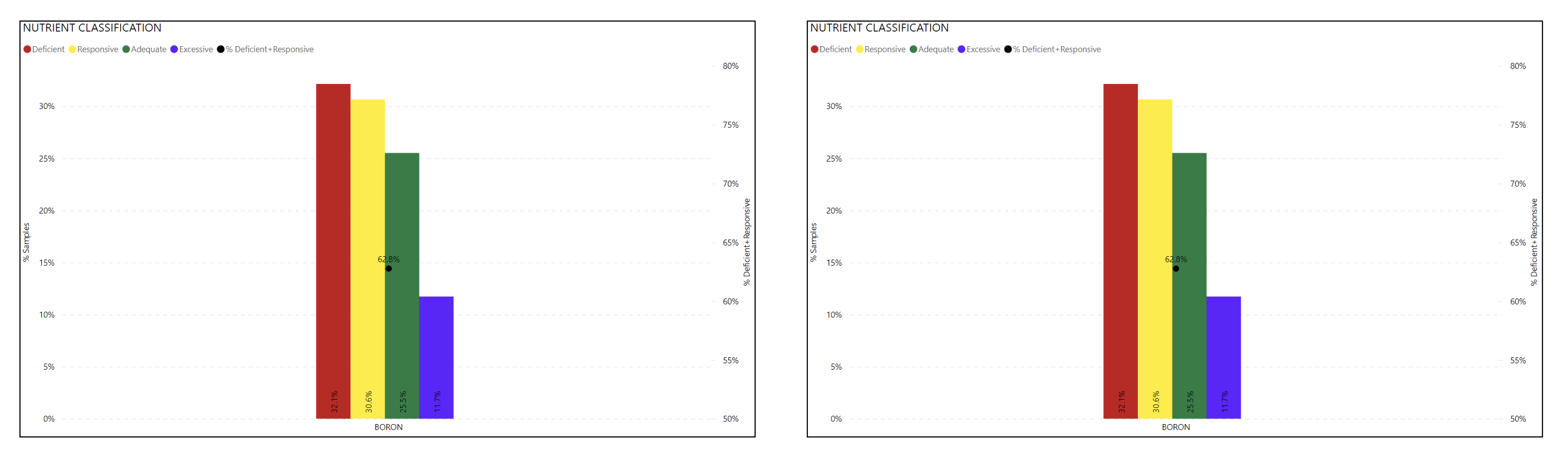
Overall, these insights are supported by WinField® United NutriSolutions® tissue sampling data from 2020. These graphics show that more than 62% of 2020 corn tissue samples were deficient in or could benefit from a boron application. Talk with your agronomist about tissue testing or making a boron application, especially if recent heavy rains occurred in your area.
Overall, these insights are supported by WinField® United NutriSolutions® tissue sampling data from 2020. These graphics show that more than 62% of 2020 corn tissue samples were deficient in or could benefit from a boron application. Talk with your agronomist about tissue testing or making a boron application, especially if recent heavy rains occurred in your area.
Why is it important to apply boron?
Boron is relatively immobile in the plant until it begins to move to the reproductive parts of the plant during the onset of pollination. As boron moves to the tassel and silks, it becomes deficient in the leaf tissue. Since one of boron’s other jobs is to move sugars throughout the plant, this deficit during the beginning of reproduction means the plant runs a risk of less efficient sugar transport. Fixing a boron deficiency can help the plant optimize photosynthesis as well as sugar transport, which are both necessary for corn plants to thrive.
What could an application of boron do?
Targeting boron at the leaf tissue can help mobilize sugars and feed the newly fertilized kernels in the beginning stages of blister and milk. Boron also helps with flowering set and fruiting while additionally playing a role in pollen survivability and silk rigidity. And boron helps organize cell structure, particularly in the xylem and phloem, the “transportation highways” of the plant. This organization can help increase cellular activity and boost nitrogen efficiency and carbohydrate metabolism.
When should I apply boron?
Boron should be applied between the late vegetative and R1 growth stages to optimize efficacy. Micronutrients like MAX-IN® Boron can be applied on corn between VT and R1 at a rate of 12-16 fl. oz. per acre. Such foliar applications can help improve the boron status of corn and reduce the potential for yield loss.
What else can I use in my tank mix?
MAX-IN Boron can be tank mixed with fungicides as well as with adjuvant technologies such as MasterLock® adjuvant. However, be sure to read and follow fungicide label instructions before applying between the V8 and VT growth stages. MAX-IN Boron can also be tank mixed with insecticides. Consult your agronomist to ensure you are applying the correct tank-mix partners at the correct rates and at the optimal times.
Don’t let a treatable boron deficiency take a toll at harvest. Contact us to manage nutrients so you can harvest the kind of corn crop you’ve worked so hard to achieve.
Don’t let a treatable boron deficiency take a toll at harvest. Contact us to manage nutrients so you can harvest the kind of corn crop you’ve worked so hard to achieve.