Annual Legumes: More Than Just Free Nitrogen
Jul 01, 2026
What the numbers actually say about nitrogen, forage, and cattle gains
Walk through any farm supply store this fall and you'll hear the same conversation. Nitrogen prices hovering near $0.90–$0.95 per pound of actual N have a lot of growers reconsidering inputs they wrote off years ago. Annual legumes are back on the table — and not just as a cover crop footnote.But the pitch for legumes often gets oversimplified. Growers are told they can "grow their own nitrogen," which is absolutely true. The highest economic value shows up when livestock are added to the system. At that point, legumes shift from an input-cost reduction tool to a revenue-generating asset.
Long-term forage evaluation data from Mississippi State University, compiled by Dr. Josh White, along with grazing system demonstrations conducted by Dr. Rocky Lemus, tell a more complete story. The data breaks cleanly into two questions: what legumes are worth when you're just chasing nitrogen credits, and what they're worth when cattle are in the picture.
The Nitrogen Credit Case: Real Cost Savings
Annual legumes do fix meaningful nitrogen. That much is not in dispute. To calculate the benefit, we analyzed data published by Mississippi State University from 2015 to 2025.What the Mississippi State trials make clear is that the cost-effectiveness of the nitrogen credit depends almost entirely on the seeding rate — not on which species fixes the most.
Dr. White's forage evaluations estimated nitrogen contribution using a standard forage sampling calculation:
N (lb/A) = ((Sample Weight × %Dry Matter) × 43,560) × (CP% ÷ 6.25)
Any grower can run this on their own operation. Simply harvest a 1-square-foot sample, weigh it, send it to a forage lab, and plug the sample weight, crude protein and dry matter percentages into the formula. One important caveat: the formula gives you total nitrogen in the biomass, not plant-available nitrogen. Mineralization timing, soil temperature, and moisture conditions all affect release. As soil microbes break down the legume biomass, not all of that nitrogen becomes available to the next crop right away. A practical rule of thumb is that about 60% becomes plant-available in the first season, while the rest is released more gradually over time as decomposition continues.
Table 1. Nitrogen Contribution and Net Return — Mississippi State University Forage Evaluations (Dr. Josh White)

Small-Seeded Species Win — Here's Why
Balansa clover was sown at 4 pounds per acre and still averaged 120 pounds of nitrogen per acre in the trials. At current seed prices, that works out to roughly $0.10 per pound of nitrogen — less than a seventh of what you'd pay for synthetic. Persian clover, another small-seeded option, tracked closely behind at about $0.13/lb.Berseem tells a different story. It produced the highest raw nitrogen numbers in the dataset — 160 pounds per acre on average — but requires 20 pounds of seed at $3.50 per pound. The seed bill eats about half of the nitrogen credit. Net value after seed cost ends up around 20% less than balansa clover’s, despite producing 33% more nitrogen.
Hairy vetch is the cautionary tale. Strong nitrogen producer, but 25 pounds of seed per acre at $2.20 leaves growers paying roughly $0.50 per pound of nitrogen. Unless you have a reliable seed source at a significant discount, the math is hard to justify on a pure fertility basis.
One detail worth noting: both crimson and balansa are hard-seeded and heavy re-seeders. Let either species run through its full flowering cycle and you should expect volunteer plants in future years. That can work in your favor if it fits the rotation, or it can complicate things if it doesn't. Either way, it's a management variable worth accounting for.
The seeding rates shown are those used in these monoculture trials. Rates may vary by location, which will affect both cost and, potentially, yield.
Weather Makes These Numbers Move — A Lot
The other honest takeaway from the MSU forage trials is how much variability exists year to year. In some seasons, species performance shifted several-fold depending on fall establishment conditions and spring rainfall. That is not a flaw in the data — it is the data.Nitrogen contribution from legumes is a range, not a guarantee. In a dry establishment year following a late corn harvest, a grower expecting 120 pounds of nitrogen might get 60. Building that range into the economic plan matters more than optimizing on the average number.
When Cattle Are Involved, the Math Gets Interesting
The fertilizer replacement calculation above is the right framework for row crop-only operations. For anyone running cattle, it is the wrong question.Here is the first thing to understand about grazing legumes: most of the nitrogen does not leave the field. Research consistently shows that 70–90% of consumed nitrogen is returned through manure and urine. The 10–20% that leaves does so in animal tissue. The real fertility concern in grazed systems is not nitrogen removal — it is uneven distribution, with nutrients concentrating around water sources and shaded areas.
What grazing adds to the ledger is forage value. And as the Mississippi State grazing demonstration data shows, that value tends to be substantially larger than the nitrogen credit alone.
Berseem Clover: Short Window, Strong Numbers
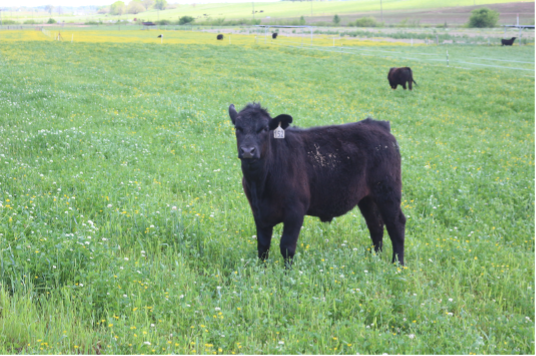
Dr. Lemus's grazing demonstrations on Frosty berseem clover produced cattle performance numbers that would get anyone's attention. Average daily gain approached 3 pounds per day during the demonstration period.Table 2. Berseem Clover Grazing System Performance — Mississippi State University (Dr. Rocky Lemus)

The combined system value — forage plus nitrogen credit — came in near $195 per acre at a fairly conservative $0.80 per pound liveweight. The nitrogen credit alone would have been $47. Grazing more than tripled the economic return from the same stand.
The honest limitation here is the grazing window. Berseem produced exceptionally well, but across a roughly 31-day period. For operations that can concentrate cattle effectively and move them through quickly, that is a genuine advantage. For operations with large acreage and less grazing infrastructure, the short duration is a logistical challenge worth planning around.
Balansa in a Ryegrass Mix: A Different Kind of Value
Where berseem functioned as a high-intensity, short-duration grazing event, balansa contributed differently — extending the grazing season and improving total output across a longer period when mixed with annual ryegrass.The ryegrass-balansa system data from Dr. Lemus's work is the most compelling comparison in the dataset, because it directly pits the legume system against fertilized ryegrass.
Table 3. Grazing System Economics Comparison — Mississippi State University (Dr. Rocky Lemus)

Ryegrass with balansa produced 89 more pounds of beef per acre than fertilized ryegrass — roughly a 32% increase in gain — while also reducing nitrogen inputs by around 75 pounds per acre. At current nitrogen prices, that input reduction represents approximately $70 per acre in fertilizer value.
Add it together and the ryegrass-balansa system generated about $142 per acre more than fertilized ryegrass, using the same conservative liveweight assumptions. That gap is large enough to matter on most operations.
Balansa also thrives on wet, poorly drained soils where other legumes struggle — a practical advantage in Gulf Coast and lower Delta environments where winter waterlogging is common.
Planting Date and Corn Maturity: What Actually Matters
A fair question for row crop operations is what happens to corn yield when planting gets pushed back behind a legume cover. The short answer from MSU trial data: yes, delayed planting dates can reduce yield, but the mechanism matters more than the delay itself.In much of the Southeast, the yield penalty from delayed corn planting is driven primarily by pushing pollination and grain fill into hotter late-summer conditions — not by cooler soils at planting. By late April in Mississippi, cover crop residue generally does not hold soil temperatures meaningfully below bare ground levels observed earlier in the month.
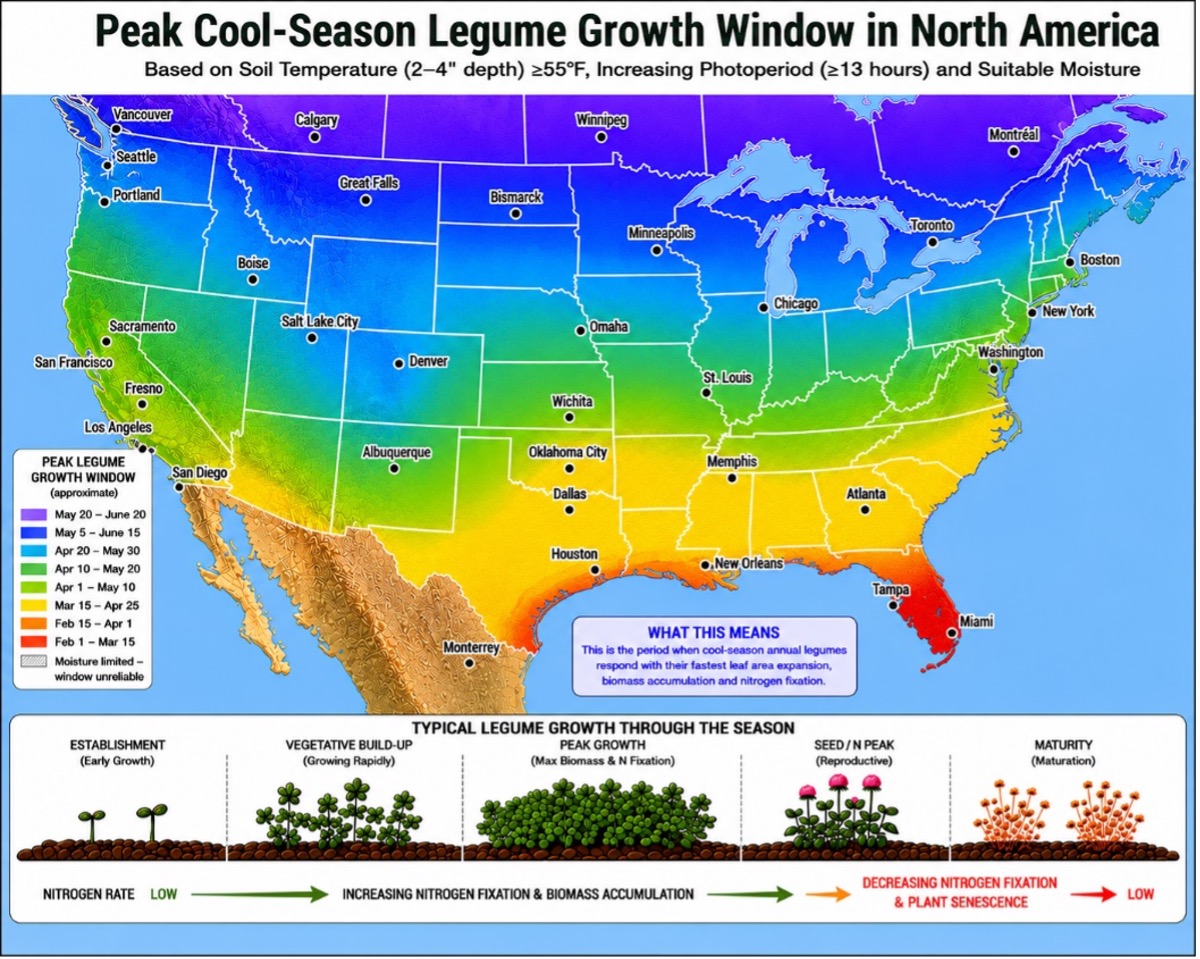
The practical implication is that shorter-maturity corn hybrids may align better with delayed planting windows in legume-based systems. Rather than accepting a penalty by planting the same hybrid later, selecting a hybrid calibrated to the actual available growing season is a management lever. In dryland environments especially, that hybrid selection question and the nitrogen timing question are worth working through together.
It is also worth noting that the nitrogen data above represents optimal fixation — full-season growth through initial bloom. Early termination to accommodate a planting window reduces the nitrogen yield from the clover proportionally. Timing termination to coincide with or just after first bloom captures the most nitrogen fixation without sacrificing too much corn planting flexibility.
One practice used to increase legume biomass and nitrogen production is "planting green." Under this approach, corn is planted directly into a living cover crop, which is terminated shortly before or after planting. Allowing the cover crop to continue growing during this period can increase biomass production and, in the case of legumes, nitrogen accumulation. Successful planting green often requires careful planter setup and residue management. In high-residue systems, growers may utilize row cleaners, additional downforce, or alternative closing wheels to maintain consistent seed placement and emergence.
Takeaways
Legumes pencil out on nitrogen — but species selection matters more than gross productionThe highest-biomass legume is not always the most profitable nitrogen source. Small-seeded species like balansa and Persian clover consistently delivered the cheapest nitrogen in the MSU dataset, largely because low seeding rates kept establishment costs down. Evaluate cost per pound of nitrogen, not just pounds of nitrogen.
Grazing changes the economics entirely
In a livestock system, annual legumes stop being a cost reduction tool and start being a revenue source. The MSU demonstration data showed forage value consistently exceeding nitrogen credit value — sometimes by a factor of three or more. That shift in framing changes how the system pencils out, and it changes which species look most attractive.
Match the species to the role
Berseem delivers intense, high-quality forage over a short window. Balansa extends grazing season and integrates well into ryegrass systems, with the added advantage of tolerating wet soils. Crimson clover is a low-cost, stable performer that re-seeds aggressively. Persian establishes quickly in fall. Hairy vetch is a strong nitrogen producer but is expensive to seed — its economics improve significantly if you can source seed below retail.
Build variability into the plan
The MSU trial data show significant year-to-year variation in legume performance. Nitrogen contribution from these species is a range depending on fall establishment and spring growing conditions — not a fixed input. Operations relying on legume nitrogen for the following crop should plan around the low end of the expected range in drought years, not the average.
Bottom Line
Annual legumes deliver their strongest economic performance when they are evaluated as part of an integrated system — not just as a fertilizer substitute. For livestock operations in the South, the MSU data make a straightforward case: legume-based systems can produce substantially more value per acre than either fertilized grass systems or legumes managed purely for nitrogen credit.The place to start is matching species to your system. What is your stocking rate? What is your termination window? Do you have wet ground that limits your grass options in winter? The answers point toward different species and different management approaches, but the economic logic holds across most Southern livestock and row crop systems at current input prices.
Questions? We're happy to help. Reach out to us here.