By Isaac Anderson, Land O'Lakes Market Development Agronomist
To maximize profitability potential, every dollar spent on crop protection products must deliver the best possible return on investment. That’s where adjuvants come in. They’re the unsung heroes of the tank mix, and they can help enhance the performance of herbicides, fungicides and insecticides, ensuring that every spray drop works harder to support your bottom line.
Adjuvant is a broad term that includes several specific product categories. Understanding which adjuvants to use for a specific spray application can significantly impact outcomes. Let’s break down the key classes of adjuvants and explore how they can help improve uptake, reduce drift and enhance spray performance.
Prevent Probable Herbicide Tie-Up with Water Conditioners
Water is the carrier for nearly every crop input, but not all water is the same. Hard water, which contains positively charged ions like calcium, magnesium and sodium, can deactivate certain herbicides by binding with their active ingredients before they reach the target weeds.
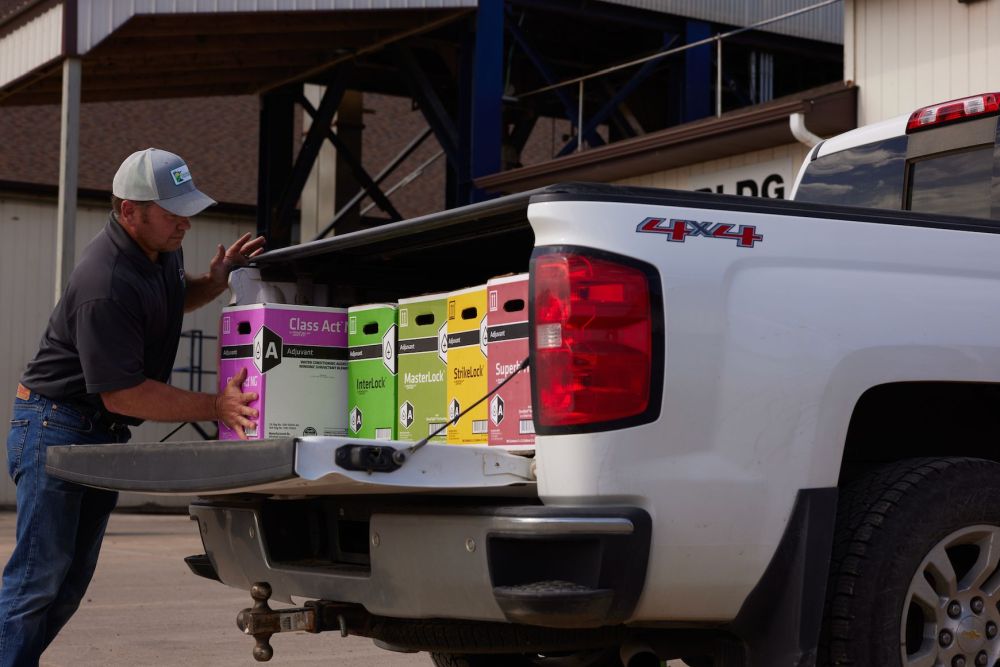
Water conditioners, primarily ammonium sulfate (AMS)-based products, contain negatively charged anions that tie up hard water cations, supporting herbicide formulation stability in the tank. Products like Class Act® NG® adjuvant combine AMS with non-ionic surfactants to improve herbicide coverage. Additionally, Class Act NG adjuvant contains CornSorb® humectant technology to help drive the herbicide into the plant for optimal activity. Compared to AMS, Class Act NG adjuvant increases glyphosate and Enlist® One uptake by 2.1x and 1.4x, respectively.1
When to use a water conditioner: Always. Conditioning your water helps ensure herbicides, especially glyphosate, remain active and do the job you’re paying for.
Keep Applications on Target with Drift Reduction Agents
Spray drift is a major concern, not only from an environmental standpoint but also in terms of product efficiency. Small droplets can easily drift off target, reducing coverage and increasing the risk of unintended exposure to neighboring crops.
Drift reduction agents (DRAs), such as InterLock® adjuvant, help control spray droplet size, preventing the creation of ultra-fine particles that the wind can carry away. Unlike older polymer-based DRAs that create excessively large droplets, Interlock adjuvant is designed to balance droplet size. Research shows InterLock adjuvant can improve on-target spray potential by 33% compared to an application without InterLock adjuvant.2 Its unique formulation helps improve canopy penetration and absorption, reducing the risk of excessive runoff.
When to use a DRA: For any post-emergence herbicide, fungicide or insecticide application where drift control is a concern.
Help Maximize Coverage with Surfactants
Surfactants improve the spread and adhesion of spray droplets on leaf surfaces. Without them, water-based sprays tend to bead up on waxy leaves, reducing the surface area in contact with the plant and limiting active ingredient uptake.
Non-ionic surfactants (NIS), like those found in Class Act NG adjuvant, help break surface tension, focusing on droplets spreading evenly across the leaf. Additionally, surfactants improve penetration, helping crop protection products work more effectively.
When to use a surfactant: In nearly all foliar spray applications to maximize contact and absorption potential of the active ingredient.
Enhance Herbicide Uptake with Oil-Based Adjuvants
Oils play a critical role in breaking through the protective wax layers on weed leaves, particularly under hot and dry conditions when plants develop thicker cuticles. However, not all oil adjuvants are the same.
-
Crop Oil Concentrates are usually petroleum-derived and are beneficial for improving coverage when leaf surfaces prevent sufficient coverage (for example, hairy or waxy surfaces).
-
High Surfactant Crop Oil Concentrates blend surfactants with oil to enhance spreading and uptake. They can often be applied at lower rates than standard crop oils.
- Methylated Seed Oils are more aggressive and are particularly effective for herbicides like clethodim, which require oil for activation. They may also be beneficial when crops are drought stressed and have developed thicker cuticles.
- High Surfactant Methylated Seed Oils contain surfactants that enhance leaf coverage. They are typically applied at lower rates than standard methylated seed oils. StrikeLock® adjuvant is an example, combining oil with a DRA, helping ensure optimal spray efficiency while maintaining on-target application. Research shows up to 34% more Enlist® One leaf uptake when StrikeLock adjuvant is added to the tank mix.3
When to use an oil-based adjuvant: When applying oil-loving herbicides such as Enlist® herbicide, Liberty® herbicide or clethodim, particularly in hot and dry conditions where weeds develop thicker cuticles.
Adjuvants Make Economic Sense
It’s natural to look for ways to cut costs when budgets are tight. Adjuvants may seem like an easy place to trim expenses, but removing them can reduce the performance potential of high-cost inputs, possibly costing more in lost efficacy and additional applications.
For example, research conducted by WinField® United reveals how premium adjuvants can enhance spray applications:
- StrikeLock adjuvant has been shown to increase spray coverage on a weed by 34% when applied with Enlist herbicide.3
- Interlock adjuvant increased spray coverage by 33%, helping ensure more of the applied product reaches its intended target.2
- MasterLock® adjuvant, an NPE-free drift and deposition aid designed for later-stage fungicide and insecticide applications, has demonstrated a 5.7-bushel-per-acre yield increase in corn4 and 3.7 bushel-per-acre yield increase in wheat5 when paired with a premium fungicide.
With adjuvants making up a relatively small percentage of overall application costs (often just 10-15%), their benefits may far outweigh the expense. They often enhance the performance potential of herbicides, fungicides and insecticides, leading to more effective pest control, improved yield potential, fewer resprays and better return on investment potential. Curious about how to use adjuvants with drone applications? Learn more from WinField United agronomist, Tyler Steinkamp, here.
Mitigate Drift with the Help of Adjuvants
The regulatory landscape is evolving with the EPA’s new Herbicide Strategy, which focuses on reducing off-target herbicide movement and improving application accuracy to protect sensitive environments. The Strategy recognizes the value of adjuvants, particularly oil-based DRAs, in mitigating drift and volatilization. In some cases, using a DRA may allow you to reduce buffer zones. For more information about the latest regulations, consult with your agronomic advisor.
Getting the Most Potential from Your Crop Protection Investment
Adjuvants may not be the first thing on your mind when planning an application, but they play a critical role in assisting your crop protection products to deliver maximum potential. By focusing on improving coverage, enhancing uptake, and reducing drift, adjuvants help your tank mix work harder — giving you better weed, insect and disease control for every dollar spent.
As always, work closely with your local GreenPoint Ag team to match the right adjuvants to your application.
12024 WinField United Innovation Center Controlled Environments study comparing herbicide leaf uptake comparing using Class Act NG adjuvant v. dry AMS.
2In 2023, InterLock adjuvant reduced the number of driftable fines from the baseline treatment by an average of 33% across four herbicide tank mixtures and two nozzles.
32024 WinField United Innovation Center Controlled Environments study comparing herbicide leaf uptake comparing using StrikeLock adjuvant + Enlist One v. Enlist One alone.
4WinField United. 14 studies, eight states, all fungicides. 2012-2017.
5WinField United. 12 trials, five locations across the U.S. and Canada. 2019-2021.
All photos are either the property of WinField United or used with permission.
© 2026 WinField United. Important: Before use always read and follow label instructions. Crop performance is dependent on several factors many of which are beyond the control of WinField United, including without limitation, soil type, pest pressures, agronomic practices and weather conditions. Growers are encouraged to consider data from multiple locations, over multiple years and to be mindful of how such agronomic conditions could impact results. Class Act, CornSorb, InterLock, MasterLock, NG and WinField are trademarks of WinField United. All other trademarks are the property of their respective owners.